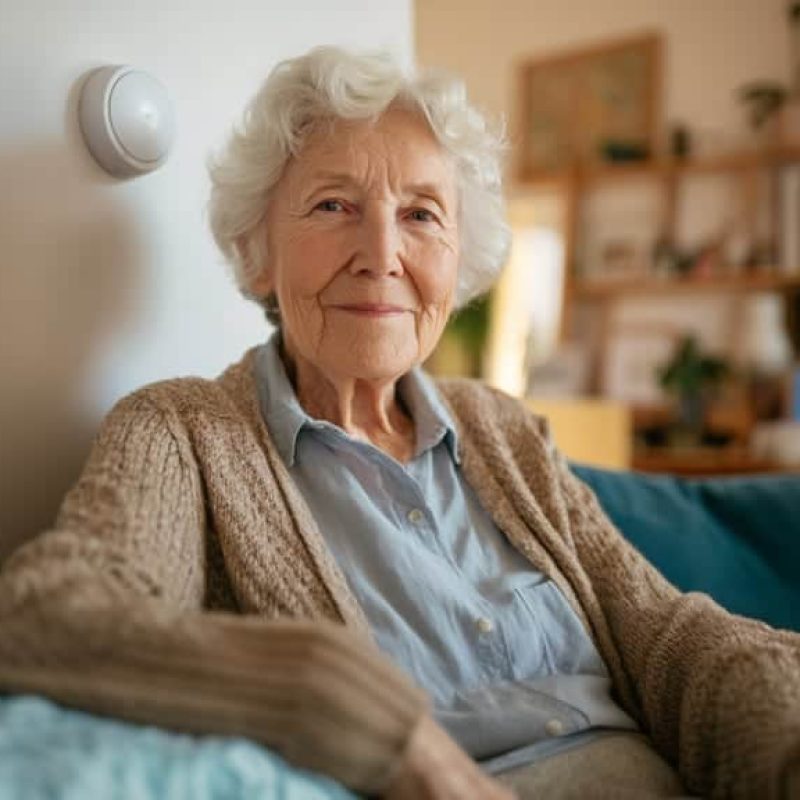
The best in-home monitoring systems for seniors living alone give families something a phone call can’t: real-time awareness when something is wrong — even when the senior doesn’t know it yet. As a registered nurse, I’ve sat across from hundreds of worried adult children who ask some version of the same question: “My mom insists on staying home, and I’m terrified something is going to happen and nobody will know.” I’ve had that conversation more times than I can count. This guide is my answer.
In-home monitoring systems are different from the wearable medical alert devices I’ve covered elsewhere on this site. Wearables are reactive — they depend on the senior pushing a button or falling hard enough to trigger a sensor. In-home monitoring works passively, in the background, whether the senior does anything or not. Motion sensors track movement through the house. Cameras let family members check in from anywhere. Activity monitors flag changes in daily routine before a crisis develops.
This isn’t a sponsored list. It’s what I’d recommend to my own family.
Best In-Home Monitoring Systems for Seniors Living Alone — How They Differ From Wearables
Before I get into specific systems, I want to make sure this distinction is clear — because families often buy the wrong type of technology for the problem they’re actually trying to solve.
Medical alert wearables are excellent for emergencies. They’re designed for the moment something goes wrong. But they require the senior to be conscious, aware, and physically able to activate the device. If your parent falls and loses consciousness, a wearable button does nothing. If they’re confused and disoriented, they may not think to press it.
In-home monitoring systems fill a different gap. They watch the environment, not just the person. A motion sensor notices when someone hasn’t moved through the kitchen by 10 a.m. A door sensor detects if a parent with dementia leaves the house at 2 a.m. A camera lets a daughter in another state check in visually before she calls — and know whether to worry.
For most seniors living alone, the ideal setup combines both. A wearable for emergencies. A home monitoring system for ongoing peace of mind. But if you’re just starting to think about safety, understanding in-home monitoring is the right place to begin.
The Main Types of In-Home Monitoring Systems
There is no single best in-home monitoring systems for all seniors living alone. The right choice depends on your parent’s level of independence, their comfort with technology, and what concerns you most. Here’s how each category works.
Motion Sensor Systems
Motion sensors are small wireless devices placed throughout the home — bedroom, bathroom, kitchen, living room. They track movement patterns over time and alert caregivers when something is unusual. If your parent typically passes through the kitchen by 8 a.m. and the sensor hasn’t triggered by 11 a.m., you get a notification on your phone.
These systems are ideal for privacy-conscious seniors who would refuse a camera but still need monitoring. There’s no video and no audio — just movement data. For families managing early-stage dementia or seniors who resist more visible technology, motion sensors are often the least invasive starting point.
The limitation is that motion sensors can’t tell you what happened — only that movement did or didn’t occur when expected. They won’t detect a fall directly, only the absence of movement that should have followed.
Indoor Camera Systems
Indoor cameras give family members the ability to check in visually from anywhere via a smartphone app. Modern systems offer two-way audio — you can see and speak with your parent in real time. Many also include motion-triggered alerts and night vision.
The eufy Indoor Cam E220 is a strong option for families who want reliable monitoring without a monthly subscription fee. It offers 2K video, two-way audio, 360-degree coverage, and instant motion alerts. For families who want professional monitoring layered on top, SimpliSafe’s indoor cameras integrate seamlessly with their monitoring plans starting at $32.99 per month.
The honest conversation about cameras is this: privacy matters. Some seniors will flatly refuse them, and that refusal deserves respect. Cameras work best in common areas — the kitchen, living room, and entryway. Never in bedrooms or bathrooms. If your parent is uncomfortable with cameras anywhere in the home, motion sensors are your better path forward.
Smart Home Security Systems
Full smart home security systems combine cameras, motion sensors, door and window sensors, smoke detectors, and carbon monoxide detectors into one integrated platform managed through a single app. When a sensor triggers, the system alerts you, notifies emergency contacts, and — with professional monitoring — can dispatch emergency services automatically.
SimpliSafe consistently ranks as one of the top-rated systems for seniors because of its simple DIY setup, no required long-term contracts, and loud siren that helps seniors with hearing difficulties. ADT has been in the home security business for over 150 years and offers professional installation — an important advantage for seniors who aren’t comfortable setting up technology themselves.
Monthly monitoring fees typically run between $23 and $50 depending on the plan. Month-to-month plans are worth the slight premium — they give families flexibility as needs change without locking into a long-term commitment.
Activity Monitoring Systems
Activity monitoring systems are designed specifically for aging adults. They use a combination of sensors — door sensors, motion detectors, and sometimes bed or chair sensors — to build a picture of a senior’s normal daily routine. When that routine changes significantly, caregivers are alerted.
Aloe Care Health is one system worth highlighting. It combines voice activation, motion sensors, home temperature and air quality monitoring, and a caregiver app where family members can collaborate and share updates. It’s particularly well suited for seniors whose families want insight into daily patterns, not just emergency alerts. According to the National Council on Aging, systems like Aloe Care that monitor daily living patterns are especially valuable for early-stage dementia, where changes in routine can be the first sign of a health change.
Bed and Chair Sensors
Pressure-sensitive pads placed under a mattress or chair cushion alert caregivers when a senior gets up unexpectedly — particularly useful overnight, when fall risk is highest. If a senior with mobility issues gets up at 3 a.m. and doesn’t return to bed within a reasonable time, a family member receives an alert.
These sensors are low-visibility, low-tech, and easy to set up — which makes them a good starting point for families whose parent resists more visible monitoring technology. They require no action from the senior and are completely invisible once in place.
What to Look For Before You Buy
With so many systems on the market, here’s what I tell families to focus on:
Ease of use for the senior. Passive systems that work in the background are almost always a better fit for older adults than systems requiring daily interaction.
Cellular backup. Look for systems that maintain connectivity even when Wi-Fi goes down. A system that fails during a power outage is useless exactly when you need it most.
No long-term contracts. Needs change. Flexibility matters. Avoid systems that lock you into a year or more of monitoring fees.
Professional monitoring option. For seniors living fully alone, a system with optional professional monitoring — where trained agents can assess a situation and dispatch help — adds a critical layer beyond family notifications alone.
Simple caregiver interface. The app that family members use should be straightforward. If it takes 20 minutes to figure out how to check on your parent, it won’t get used consistently.
The Conversation You Need to Have First
Most buying guides skip this part. I don’t, because in my nursing career I’ve watched families set up cameras and sensors without telling their parent — and I’ve watched it destroy trust when the parent found out. Surveillance without consent isn’t protection. It’s a violation.
The conversation goes better when you lead with love, not fear. Instead of “I’m worried you’re going to fall and nobody will know,” try “I want to feel connected to you even when I can’t be there. Would you be open to something that gives us both a little more peace of mind?”
Framing monitoring as a tool for independence — not a signal of decline — changes everything. A motion sensor system means your parent doesn’t have to check in with you three times a day to prove they’re okay. A camera means a quick video call to say good morning instead of a worried drive across town. When seniors understand that monitoring gives them more freedom, not less, the resistance often softens.
Start with the least invasive option your parent will accept. A door sensor and one motion detector is a better outcome than the perfect system that sits in a box in the closet because your parent refused to allow it.
My Recommendations by Situation
Choosing the best in-home monitoring systems for seniors living alone comes down to matching the technology to your specific situation. Every family’s situation is different. Here’s how I’d match a system to a specific need:
For the privacy-conscious senior who refuses cameras: Start with a motion sensor system in the bedroom, bathroom, and kitchen. Set alerts for unusual inactivity. This gives families meaningful safety data without any video.
For the senior whose family lives far away: An indoor camera system with two-way audio — SimpliSafe or a standalone eufy camera — gives distant family members the ability to check in visually and communicate in real time. Pair it with a medical alert wearable for complete coverage.
For the senior with early-stage dementia: An activity monitoring system that tracks daily patterns is worth the additional cost. Changes in routine are often the earliest indicators of a health change, and having that data gives families a meaningful head start.
For the senior most concerned about home security: A full smart home system like SimpliSafe or ADT — with door sensors, motion detectors, cameras, and professional monitoring — provides the most comprehensive coverage.
For the senior who gets up frequently at night: A bed sensor paired with a motion detector in the bathroom is a simple, affordable solution that provides meaningful fall protection without requiring any technology adoption from the senior.
Getting Started
If you’re feeling overwhelmed, start with a conversation. Find out what your parent is willing to accept. Pick one system that addresses your most pressing concern. Set it up, get comfortable with it, and add layers as needs change.
The families I’ve seen navigate this well are the ones who approached it as a collaboration — not a decision made for the senior, but one made with them. That’s the difference between a monitoring system that builds trust and one that damages it.
If you’re also evaluating wearable safety devices — medical alert systems, fall detection smartwatches, and personal emergency response devices — I’ve covered those in my guide to the best personal safety devices for seniors living alone. Together, a wearable device and a home monitoring system give seniors and their families the most complete safety net available in 2026.
The goal isn’t to eliminate every risk. The goal is to make sure that when something happens — and eventually, something always does — help is never far away.
