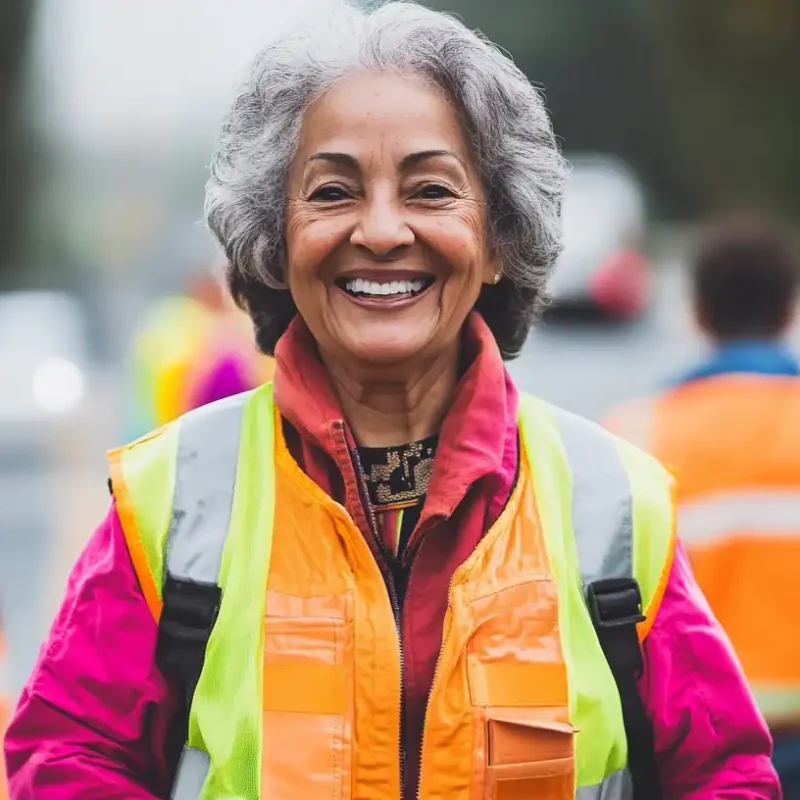
Older adults contributing to society is something I have witnessed throughout my nursing career — and it is far more common than most people realize. Whether through volunteering, caregiving, mentoring, or simply showing up for their communities, older adults bring experience, patience, and purpose that cannot be replicated. In this article, I want to share what that contribution looks like, why it matters, and how we can better support it.
As a nurse, I’ve watched this play out at the bedside and in the community for years. The patients who seem to age most vigorously — the ones who stay sharp, stay motivated, stay connected — are almost always the ones who have somewhere to be and someone counting on them. They're volunteering. Some are mentoring. Others are teaching grandchildren, leading book clubs, advocating for causes they believe in. All of them are contributing, and it shows.
So this article is about why older adults contributing to society matters — not just for communities, but for the people doing the contributing.
The Science Behind Purpose and Longevity and Why Older Adults Contributing to Society Matters
The connection between a sense of purpose and healthy aging isn’t anecdotal — it’s one of the better-supported findings in gerontology research. A landmark study published in JAMA Psychiatry found that older adults with a strong sense of purpose had significantly lower rates of cognitive decline, disability, and death over a fourteen-year follow-up period.¹
Purpose activates what researchers call the behavioral and biological pathways of resilience. When you have a reason to get up in the morning — a commitment, a responsibility, someone or something you’re showing up for — your body and brain respond differently than when you don’t. Sleep improves. Inflammation markers decrease. Cognitive engagement stays higher.²
What’s striking is that the benefit isn’t limited to grand gestures. It doesn’t require running a nonprofit or writing a book. Small, consistent acts of contribution — showing up to tutor a child every Tuesday, tending a community garden, calling a lonely neighbor — produce measurable effects on wellbeing. The scale matters less than the regularity and the sense that what you’re doing counts.
How Older Adults Contributing to Society Make a Difference
If purpose is the mechanism, volunteering is one of the most studied expressions of it in older adults. The research on senior volunteering is unusually consistent across different populations and study designs.
Older adults who volunteer show lower rates of depression, better self-reported health, and in some studies, lower mortality than non-volunteers.³ A review published in BMC Public Health found that volunteering was associated with reduced risk of depression and improved life satisfaction across multiple countries and age groups.⁴
The explanation isn’t complicated. Volunteering gets people out of the house, into social contact, doing something that feels meaningful. It structures time that might otherwise drift. It creates a sense of competence — the feeling that you’re good at something and that something needs doing. For people navigating the identity shifts that come with retirement, it can provide a new answer to the question of who you are and what you’re for.
In the United States, older adults are among the most consistent volunteers in the country. According to the Corporation for National and Community Service, adults over 55 contribute billions of hours of volunteer service annually — an economic contribution valued in the hundreds of billions of dollars.⁵ That’s not a footnote to the story of American civic life. That’s a load-bearing wall. Older adults contributing to society through volunteer work is one of the most well-researched health behaviors in gerontology.
Mentoring and the Transfer of Hard-Won Knowledge
There is a type of knowledge that doesn’t live in books or databases. It lives in people who have made decisions under uncertainty, navigated failure, built something over time, and learned what actually works versus what sounds good in theory. That knowledge — practical, embodied, relational — is one of the most valuable things older adults have to offer, and mentoring is how it moves.
Mentoring relationships benefit both parties. The person being mentored gains access to guidance and perspective they couldn’t get any other way. The mentor gains something too: a renewed sense of their own expertise, a connection across generations, and the satisfaction of watching someone grow with their help.
Research on formal mentoring programs consistently shows benefits for older adult mentors including improved mood, greater sense of purpose, and in some studies, better cognitive function.⁶ The act of organizing what you know well enough to teach it is itself cognitively demanding in the best way — it keeps mental pathways active that might otherwise go quiet.
Mentoring doesn’t require a formal program. Mentoring doesn't require a formal program. It happens in families when grandparents teach grandchildren to cook, garden, fish, or fix things. In neighborhoods, a retired teacher helps a struggling student. Workplaces benefit too, when someone with decades of experience takes a younger colleague under their wing. These informal transfers of knowledge are happening constantly, largely invisibly, and they matter enormously. This is older adults contributing to society in its most personal and lasting form.
Civic Engagement — Older Adults as Democracy’s Most Reliable Participants
If you want to understand who actually shows up for democracy — who votes, who attends city council meetings, who writes letters to elected officials, who runs for local office — the data points consistently toward older adults. By nearly every measure of civic participation, older Americans are the most engaged age group.⁷
This isn’t accidental. It reflects a lifetime of accumulated investment in community — in the schools, the parks, the local institutions that people spend decades caring about. It also reflects the perspective that comes with having watched how decisions play out over time. Older adults have seen enough cycles of change to understand that civic engagement isn’t a single act but a long-term practice.
Their involvement matters beyond just their own interests. Older voters and advocates push issues onto public agendas that might otherwise be ignored — healthcare access, housing affordability, social services, long-term care policy. In communities where older adults are actively engaged, those issues get heard. In communities where they’re not, they often don’t.
Creativity, Culture, and the Contributions That Outlast Us
Some of the most significant contributions older adults make to society aren’t measured in hours or dollars — they’re measured in stories told, traditions kept alive, art made, and memories preserved.
Many people find that creativity deepens in later life rather than diminishing. Free from career pressures and the constant demands of raising children, older adults often discover or return to creative pursuits — writing, painting, music, woodworking, gardening — and bring to them a depth of life experience that simply wasn’t available at 35. The result is often work of remarkable authenticity.
Beyond individual creative expression, older adults serve as the living memory of communities. They remember what the neighborhood looked like before, what the old traditions were, what was tried before and why it didn’t work. This institutional memory is genuinely irreplaceable. When it’s lost — when communities fail to draw on the knowledge of their elders — they often rediscover the hard way what older people already knew.
Cultural institutions — libraries, museums, historical societies, community theaters — are frequently sustained by the volunteer labor, financial support, and board leadership of older adults. Without that investment, many of these institutions wouldn’t survive.
Supporting the Next Generation — The Grandparent Effect
One of the most direct and personal forms of older adults contributing to society happens within families, and its effects ripple outward in ways that are hard to fully quantify.
Grandparents in the United States provide an enormous amount of childcare — often making it possible for parents to work, to pursue education, or simply to manage the relentless demands of raising children. According to AARP, more than 2.7 million grandparents are raising grandchildren as primary caregivers, and millions more provide regular supplemental care.⁸
The benefits for children are well documented. Children who have close relationships with grandparents show better emotional adjustment, greater resilience, and stronger family identity.⁹ For older adults, the relationship is equally beneficial — grandparenting is associated with lower rates of depression, higher reported life satisfaction, and a strong ongoing sense of purpose.
The intergenerational relationship works in both directions. Grandchildren bring energy, novelty, and connection to the present moment. Grandparents bring stability, perspective, and unconditional presence. Both parties benefit from the exchange in ways that neither fully recognizes in the moment.
What Gets in the Way of Older Adults Contributing to Society— and How to Remove the Barriers
If contribution is this good for older adults, why don’t more people engage in it? The barriers are real, and they deserve acknowledgment.
Physical limitations stop some people before they start. If mobility is difficult, traditional volunteering can feel inaccessible. But most organizations can accommodate a range of abilities, and remote and virtual opportunities have expanded dramatically — tutoring, mentoring, phone-based support, and advisory roles can all be done from home.
Social isolation is both a barrier and a consequence of not contributing. People who are isolated have fewer pathways into community engagement. This is where community organizations, faith communities, senior centers, and even primary care providers can play a meaningful role — connecting older adults to opportunities they might not find on their own.
Ageism — the assumption that older adults have little left to offer — is perhaps the most insidious barrier. It comes from outside, in the form of organizations that overlook older volunteers in favor of younger ones. And it can come from inside, in the form of internalized beliefs that one’s best contributions are behind them. Both forms are worth pushing back on.
The Bottom Line — Contribution Is Not Optional for Healthy Aging
The evidence is clear enough that I’d put it plainly: older adults contributing to society isn’t just a nice thing to do. For many people, it’s a health behavior. The research on purpose, volunteering, mentoring, and civic engagement consistently points in the same direction — staying engaged, staying connected, and staying useful are among the most powerful things older adults can do for their own longevity and quality of life.
As a nurse, I’d add this: the patients I’ve seen struggle most in later life are often those who lost their sense of purpose without finding a new one. Retirement from a career doesn’t have to mean retirement from contribution. The skills, the perspective, the relationships, and the drive that carried people through decades of work don’t disappear. They’re available to be redirected.
Find the cause, the community, the grandchild, the neighbor, the organization that needs what you have. Show up. That’s it. The research will handle the rest. Older adults contributing to society isn’t charity — it’s one of the most powerful things aging Americans can do for themselves and everyone around them.
References
- Hill, P.L., & Turiano, N.A. (2014). Purpose in life as a predictor of mortality across adulthood. Psychological Science. Retrieved from psychologicalscience.org
- Alimujiang, A., et al. (2019). Association between life purpose and mortality among US adults older than 50 years. JAMA Network Open. Retrieved from jamanetwork.com
- Okun, M.A., et al. (2013). Volunteering by older adults and risk of mortality. Psychology and Aging. Retrieved from apa.org
- Jenkinson, C.E., et al. (2013). Is volunteering a public health intervention? BMC Public Health. Retrieved from biomedcentral.com
- Corporation for National and Community Service. (2022). Volunteering and civic life in America. Retrieved from americorps.gov
- Freedman, M., & Jagannathan, R. (2021). Experience Corps and cognitive vitality in older adults. Journal of Gerontology. Retrieved from academic.oup.com
- United States Census Bureau. (2022). Voting and registration in the election of November 2022. Retrieved from census.gov
- AARP Public Policy Institute. (2023). Grandparents and other relatives raising children. Retrieved from aarp.org
- Attar-Schwartz, S., et al. (2009). Grandparenting and adolescent adjustment. Journal of Family Psychology. Retrieved from apa.org
